








Welcome to CHANAKYA DETECTIVE, India’s Trusted Investigation Agency Since 2003
(CIC): Chanakya Detective Investigation & Consultancy is a risk management and detective agency, which is conducting Corporate, Personal, Matrimonial, Cyber, Forensic Investigation and cracking most complex cases form last 15 years in Chandigarh, Panchkula, Mohali, Ambala, Zirakpur and other nearby areas.
We are one of the widest, aged, effective and reliable private detective agency in Chandigarh, Panchkula, Mohali, Ambala, Zirakpur etc. and one of the most experienced Investigation Company in India with more than 5 offices. We endeavor to transport desired results above and beyond our customers' expectations and consider privacy of the highest priority.
More
Make an Appointment
Chanakya Detective want to break all the barriers for our
clients. Any time 24*7 and 365 days our client can contact us
And take a cost free consultation on the issues, they are having
and speak to our Lady SMA ( Subject Matter Agent ) at below
mentioned contact sources.
What our Client's Say
Director Message

Detective Vikas Sonkar
Founder & Chief Investigator
Chanakya Detective Network – Chandigarh, India
At Chanakya Detective Network, our mission is to build a secure, confidential, and reliable investigative ecosystem where clients can receive hassle-free, fast, and discreet investigation services at an affordable cost. Client privacy and information security remain our highest priority at every stage of the investigation.
We specialize in providing lawful, accurate, and result-oriented detective services for individuals, corporates, and legal professionals across India. As a best private detective agency in Chandigarh, Panchkula, Mohali, Ambala, and Zirakpur, we are committed to uncovering facts with precision while strictly maintaining confidentiality, discretion, and ethical compliance. Our team follows all applicable legal guidelines, ensuring investigations are conducted responsibly and professionally.
Chanakya Detective Network understands that clients often share deeply personal, sensitive, and undisclosed information-details they may not feel comfortable sharing even with family members or close friends. We respect this trust and handle every case with empathy, professionalism, and complete secrecy.
With experienced investigators and modern investigation techniques, we deliver dependable intelligence and actionable reports for cases across Chandigarh, Panchkula, Mohali, Ambala, Zirakpur, Jalandhar, Ludhiana, Punjab, and all over India. Our consistent focus on accuracy, transparency, and confidentiality has helped establish us as one of the best private detectives in Chandigarh and Punjab.
Our mission is to provide peace of mind, clarity, and confidence to our clients by offering professional investigation services that are ethical, confidential, and result- driven, reinforcing our reputation as a trusted private detective agency in Chandigarh, Panchkula, Mohali, Ambala, Zirakpur, Punjab, and across India.
Recent Project


Explore Media

Pricing and Charges
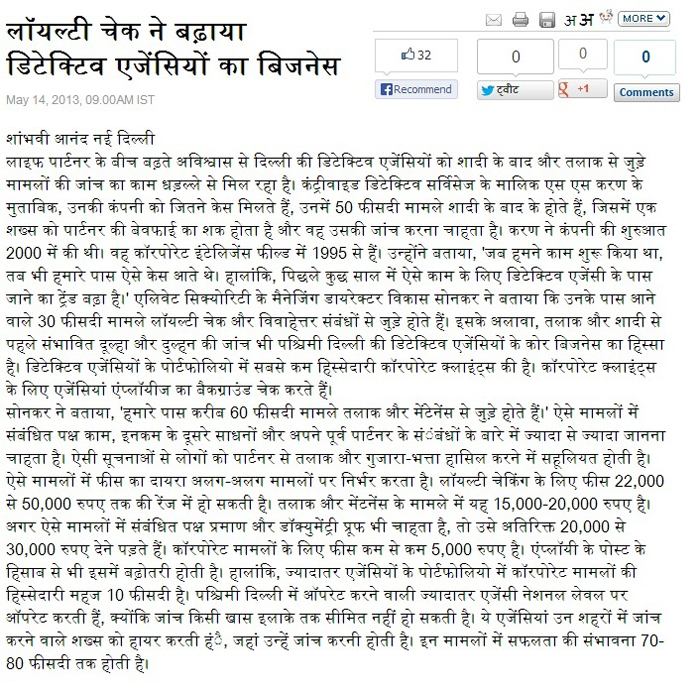
Charges and Fees: How a Private Detective Agency Designs Its Charges and Fees Transparent & Ethical Pricing Approach
At Chanakya Detective Network, we follow a transparent, ethical, and case-based pricing model. Our goal is to offer affordable yet professional investigation services without compromising confidentiality, legality, or accuracy. This client-centric approach has helped us earn recognition as a best private detective agency in Chandigarh, Panchkula, Mohali, Ambala, Zirakpur, Punjab, and across India.
When clients approach a private detective agency, one of the most common questions is about investigation charges and fee structure. At Chanakya Detective Network, we believe in complete transparency so clients understand how professional investigation fees are determined. As a trusted private detective agency in Chandigarh, our charges are based on practical, ethical, and case-specific factors rather than a fixed or arbitrary price list.
Below are the key factors that influence how a detective agency designs its charges.
Type of Case
The nature of the investigation plays a major role in determining fees. Different cases require different levels of manpower, tools, time, and expertise. For example, matrimonial investigations, corporate fraud inquiries, employee verification, surveillance, asset verification, or legal background checks all involve varying investigative techniques and resources. As one of the best private detectives in Chandigarh, Punjab, and India, we assess each case individually to ensure fair and justified pricing.
Years of Experience of the Agency
The experience and reputation of a detective agency significantly affect its charges. Agencies with many years of proven field experience, trained investigators, and a strong success record usually charge higher fees due to the quality, reliability, and accuracy they deliver. At Chanakya Detective Network, our experience enables us to handle sensitive cases professionally, minimizing risks and delivering dependable results.
Intensity and Complexity of the Case
Every investigation is unique. Some cases require short-term verification, while others demand long-term surveillance, multiple investigators, technical inputs, or continuous monitoring. The higher the intensity, complexity, and time involvement, the higher the investigation cost. Complex cases also involve legal caution, strategic planning, and detailed reporting, which influence the overall fee structure.
Distance and Area of Investigation
Geographical location is another critical factor. Detective agencies generally divide operational areas into metro, non-metro, and rural zones. Investigations closer to metro cities like Chandigarh usually involve lower logistical costs. However, cases in non-metro or rural areas require additional travel time, accommodation, and coordination, which increases operational expenses. Therefore, the farther the location from metro areas, the higher the investigation charges.





Our Blogs
-
Thursday, 14 July 2022
Reasons why you should hire a Private Detective
There are several reasons to hire a private investigator, and it's frequently useful, but when in the court of law a case or claim is necessary,
-

Monday, 27 June 2022
What is Post Matrimonial Investigation? and why it is important?
Difficulties and misconceptions after marriage are familiar between hubby and woman..
-

Friday, 17 June 2022
Is Pre-Matrimonial Investigation important?
Did you know more and more youth-full couples are taking the help of registered private investigators to conduct a background check..
FAQ: Frequently Asked Questions
This is one of the most common questions asked by clients:“Are you a licensed detective agency? Are you a government agency?”
To answer this clearly, it is important to first understand what a license actually means under Indian law.A license comes into existence only when there is a specific legal authority or regulatory body established
under state or national legislation. Such a body defines the legal framework, rights, responsibilities, operational boundaries, and compliance standards for that profession or industry.
For example:
TRAI regulates telecom services
IRDAI regulates insurance companies
RERA regulates real estate developers and builders
At present, there is no central or state-level statutory authority in India that regulates or licenses private detective agencies. Since no such regulatory framework exists, there is no concept of a “detective license”
issued by the government. Therefore, any claim that a private detective agency is “government licensed” or “authorized by police or ministry” should be viewed with caution, unless supported by written statutory
proof.
Then How Do Private Detective Agencies Operate Legally? So Private detective agencies operate like any other professional service business in India, similar to:
IT services
Consulting & advisory firms
Beauty & wellness services
Marketing or research agencies
These businesses do not require a special industry-specific license, but they must be legally incorporated and compliant with applicable laws. Legal Compliance Required for a Private Detective Agency A genuine
and lawful private detective agency is required to be: Incorporated or registered under Indian law, such as:
Proprietorship
OPC (One Person Company)
LLP
Private Limited Company
Limited Company
Registered with appropriate authorities, such as:
Registrar of Companies (ROC), (for companies/LLPs)
State Shop & Establishment Act
MSME / Udyam Registration(optional but beneficial)
GST Registration (where applicable)
As an ethical private detective agency of Chandigarh Punjab and India Chanakya Detective Network, We don't deal in any such actives, Which breaches the Indian constitution or any set of Indian Law in any manner like IT Act, telecommunications and data protection and Indian Constitution. India has a very strong Cyber Law and all such actives (like Call Details Records, WhatsApp Details, any illegal hacking) are illegal under IT Act, telecommunications and data protection and Indian Constitution. SO please note the below mentioned points
Indian Constitution
1. It is a criminal offense. It violates the right to privacy under Article 21 of the Constitution (as established in the Supreme Court's Justice K.S. Puttaswamy v. Union of India judgment) and specific laws governing telecommunications and data protection.
Information Technology Act, 2000
2. Section 72: Breach of confidentiality and privacy — If a person with lawful access (e.g., a telecom employee or official) discloses or obtains confidential electronic information without consent, punishment includes imprisonment up to 2 years, or a fine up to ₹1 lakh, or both.
3. Section 72A: Punishment for disclosure of information in breach of lawful contract — Applies to unauthorized disclosure of personal information (including CDR), with imprisonment up to 3 years, or a fine up to ₹5 lakhs, or both.
4. Section 66E: Violation of privacy (capturing, publishing, or transmitting private information without consent) — Punishment: imprisonment up to 3 years, or fine up to ₹2 lakhs, or both.
Indian Telegraph Act, 1885
5. Section 25: Damaging or tampering with telegraph lines/infrastructure to intercept/obstruct communication — Punishment: imprisonment up to 3 years, or fine, or both.
6. Section 26: Applies to telegraph officers who unlawfully intercept or disclose communications — Similar punishment: imprisonment up to 3 years, or fine, or both.
Important Notes
Lawful Access: Only authorized law enforcement agencies (e.g., police with a valid investigation) can obtain CDRs through proper channels, such as under Section 91/92 CrPC (now BNSS equivalents) or Section 5(2) of the Telegraph Act/Section 69 of IT Act (for national security/public emergency, with high-level approval). Even police cannot arbitrarily collect CDRs without justification, as ruled by courts (e.g., Karnataka High Court in 2025 emphasized this violates privacy).
Remedy: If your CDRs were illegally obtained, file an FIR under the above sections, approach the Cyber Crime Cell, or petition the High Court for privacy violation relief.
Punishments vary based on the offender (e.g., insider vs. outsider), intent, and misuse (e.g., blackmail adds extra charges). Consult a lawyer for case-specific advice, as evidence of unauthorized access is key.
Special Suggestion By Chanakya Detective Chief Investigator Detective Vikas Sonkar
My suggestion, which i am giving you, based on my 25 years pour experience of investigation trade and which is dynamic as everyone in the world, with the upgradation of technology and as AI and IT revolution changing dynamics of today.
As now every one has more than one number
2. Now we have VOIP voice over internet protocol means WhatsApp Viber Botim Telegram Signal and even social media like Instagram and facebook also provide you the option of calling and private rooms and other such application, Where CDR is just a illusion and didn't record any thing except the internet usage. And if one doing anything wrong they use such app.
3. Under the Indian Evidence Act, 1872 (now largely replaced by the Bharatiya Sakshya Adhiniyam, 2023, it is not admissibility in the court due to the legal complexity mentioned above and it could fire back, because The person who illegally obtained/disclosed the CDR (e.g., via bribery or hacking) faces separate criminal liability (under IT Act Sections 72/72A, Telegraph Act, etc.), but this does not invalidate the evidence itself.
Here you can Refer the Law and related Cases
Referance Case of Puttaswamy VS Union of India
Protection of Life & Personal Liberty (Article 21)
Information Technology Act, 2000 (21 of 2000)
Indian Telegraph Act, 1885
Not only the private detective evidence, but every evidence which is presented in the trail court, Every piece of evidence presented in a trial court must pass through a strict legal framework to ensure it is authentic and reliable as per BSA 2023. It's a very legal and technical question and can't not be defined without facing a legal technicalities. So without dive into the law, here let's talk about the cracs of the law. If we talk about the evidence, So we can divide into two parts first Primary evidence and secondary evidence.
Primary evidence
Primary evidence as per Section 62 of the Indian Evidence Act, 1872 and Bharatiya Sakshya Adhiniyam (BSA), 2023. Under the new law, primary evidence is covered under Section 57.
Primary evidence refers to the original document (Certificate Contract Agreement Digital Proof like Photo Video) itself produced for the inspection of the Court. The law prefers the original because, as it is the most reliable and least likely to have been tampered with or misinterpreted.
Direct Primary Status: Under the old act, electronic records often required special certificates (Section 65B) to be treated as evidence.
Section 57 of BSA now explicitly states that electronic or digital records—including those stored in multiple files, video recordings, or data from smartphones and servers—are considered primary evidence if they are produced from proper custody.
Secondary Evidence
In Indian law, Secondary Evidence refers to any evidence that proves the contents of an original document when the original itself cannot be produced. While primary evidence is the "best" evidence, secondary evidence is considered "alternative" or lower-quality evidence and is only admitted under specific legal conditions.
Similar to primary evidence, the rules for secondary evidence have recently transitioned from the Indian Evidence Act (IEA), 1872 to the Bharatiya Sakshya Adhiniyam (BSA), 2023.
Form of Secondary Evidence
Defined under Section 63 IEA / Section 58 BSA
Certified Copies
Mechanical Copies
Compared Copies
Counterparts
Oral Accounts
New in BSA (Section 58): Includes oral or written admissions made by a party about the contents of a document.
Detective Vikas Sonkar Opinion on the Topic
As the student of law and practicing private detective, which is the rare combination, I can suggest you to take the middle path after applying and considering both expertise.
Anonymity and Type of Evidence
Almost all the time private detective provides the evidence in the form of photographic, videographic and sometime documentary evidence (copies requested from the Actual issuing authorities), Which come under the Primary Evidence as per section 57 of Bharatiya Sakshya Adhiniyam (BSA), 2023. So it is very much admissible under the trail court or can be present at the any level of court in India. With or without giving specific private detective name.
Time Calculation and Complexity
But as per my suggestion you should not mentioned private detective agency name, because it will make the process more time consuming and lengthy as court can ask to call a private detective agency in the court and agency may or may not be comfortable to appear in the court and how long they will continue this.
Increase the Costing
They can charge a sperate amount for the same, Which can affect your cost of fighting the case.
Make it a Primary Evidence
As per the burden of proof, you are the most Eligible person to gather this evidence and that hardly matters that who obtains these proof, which matter is the given proof and evidence should be authentic and original, and obtain and present as per the given guideline under Bharatiya Sakshya Adhiniyam (BSA), 2023.
Primary And Secondary Evidence
Indian Evidence Act. 1872
Section 20 of BSA 2023
Digital Evidence BSA 2023
IEA VS BSA And Primary And Secondary Evidence
Contrary to popular belief, Lorem Ipsum is not simply random text. It has roots in a piece of classical Latin literature from 45 BC, making it over 2000 years old. Richard McClintock, a Latin professor at Hampden-Sydney College in Virginia, looked up one of the more obscure Latin words, consectetur, from a Lorem Ipsum passage, and going through the cites of the word in classical literature, discovered the undoubtable source.
Contrary to popular belief, Lorem Ipsum is not simply random text. It has roots in a piece of classical Latin literature from 45 BC, making it over 2000 years old. Richard McClintock, a Latin professor at Hampden-Sydney College in Virginia, looked up one of the more obscure Latin words, consectetur, from a Lorem Ipsum passage, and going through the cites of the word in classical literature, discovered the undoubtable source.
Contrary to popular belief, Lorem Ipsum is not simply random text. It has roots in a piece of classical Latin literature from 45 BC, making it over 2000 years old. Richard McClintock, a Latin professor at Hampden-Sydney College in Virginia, looked up one of the more obscure Latin words, consectetur, from a Lorem Ipsum passage, and going through the cites of the word in classical literature, discovered the undoubtable source.
Contrary to popular belief, Lorem Ipsum is not simply random text. It has roots in a piece of classical Latin literature from 45 BC, making it over 2000 years old. Richard McClintock, a Latin professor at Hampden-Sydney College in Virginia, looked up one of the more obscure Latin words, consectetur, from a Lorem Ipsum passage, and going through the cites of the word in classical literature, discovered the undoubtable source.
HOT LINE
Chandigarh Office: 1151, 11th Floor, D Block, Chandigarh City Center, VIP Road, Zirakpur-140603
Ludhiana Office: Sky Square, Samrala Chowk Ludhiana, Bye Pass Ludhiana, Punjab
Jalandhar Office: House No.4, G T Road, Jalandhar Cantt, Near Vajr Dwar, Jalandhar, Punjab-144001
Shimla Office: Babu Lal Estate, Lambidhar, Dhalli Chowk, Dhalli, Shimla, Himachal Pradesh-171012
Delhi Office: 10279, Gali Gyarsi Wali, Manak Pura, Karol Bagh, New Delhi-110005


